I
started composing only when I was 19. I have always
been in awe of good musicians. I had been playing around
with keyboards for some time. So I finally thought maybe
I could make something happen with music myself and
bought a professional keyboard. Initially I was just
rearranging familiar songs. I gradually pushed myself
into composing and it took almost a year before anything
sensible happened! I did have a feeling for it I guess,
but it turns out to be more difficult than what I had
thought. Buying the keyboard was the starting point.
Eventually I have expanded my equipment according to
my needs.
You
do tend to project music in your mind, but it's very
difficult to translate/interpret that into the music
that you end up composing.
Who
and what were your early influences and inspirations?
What are they now? How have you grown as a composer
and what do you see yourself as in the future?
I
think it all began with Roja. I heard the song Dil Hai
Chhota Sa on TV and I was absolutely stunned by the
music. I had never heard anything like it in my entire
life. Eventually I found out that the name of the composer
was A. R. Rahman, and the journey started from there.
I have heard everything he has composed post Roja (released)
and he continues to be the greatest influence in my
music. He has composed for nearly 60 albums and almost
95% of all his songs sound amazing to me, and the rest
are all good anyway. I don't know of any other composer
at any point in time that has been this prolific and
this good at the same time. And I hope to see much more
of his work over the next years. I probably started
composing because I saw how he was able to move me with
his music. That is very powerful.
Besides
him, I like Deep Forest, Enigma, Sting, Peter Gabriel,
Lisa Gerrard and other world musicians.
Composing
is a continuous learning process. Programming is an
aspect that you can constantly improve on. You also
get a sense for the right sound over time and the programming
becomes more detailed and well-planned. Of course you
continuously listen to what others are doing and learn
from them.
The
future remains a mystery for me. I would like to be
a good composer of melodious music, hopefully.
How
did you start experimenting with composing? Did you
start with any instrument? What is the formal music
training that you have received? How important is formal
music education for a composer?
I
didn't start off with a formal education in music, except
basic music notation and so on. I liked the keyboard
since I was very young. I do like to think of 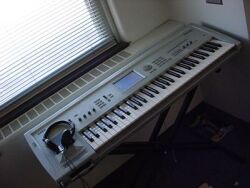 myself
as a student of music. I learn by playing other people's
music. It's a very rewarding practice. You sort of "see"
the music and how all the notes come together to create
the music and make things sound a certain way. It creates
an immense respect for the composers. It's a great way
to educate your self. You see that some songs have more
complex melodies than others in playing them, and that
some follow unusual progressions.
myself
as a student of music. I learn by playing other people's
music. It's a very rewarding practice. You sort of "see"
the music and how all the notes come together to create
the music and make things sound a certain way. It creates
an immense respect for the composers. It's a great way
to educate your self. You see that some songs have more
complex melodies than others in playing them, and that
some follow unusual progressions.
A
sound musical training is quite useful when time becomes
a constraint. One should have something to fall back
on when inspiration is lacking, especially if he/she
composes music professionally.
How
do you get inspiration for a composition and what are
the methods you use to record your ideas and develop
your compositions?
It
all starts with me sitting at the keyboard and playing
pretty random bits and pieces of music. Then, hopefully,
I chance upon a segment of music that moves me, and
I develop it. It's more of a discovery than creation
at this point. A good melody is always important to
me. However, I have to use my own sense of judgment
to say what's good and what's not. After that you put
your melody on the sequencer and start programming around
it. After the programming phase comes mixing and production,
which happens mostly on the computer. This is the most
exhaustive part of it all. Hopefully, at the end of
it all, people like it!
Heard
all your compositions on Ranoshare. Your compositions
are very melodious are have quite a wide range of influences
from new age, jazz to fusion. And somebody had also
mentioned in your Yahoo Group that you like to do BGMs
(Background Music) more. Why is that?
Thanks.
I do try to compose melodies along specific styles.
I think it helps people connect easily with the music.
But I also don't like to confine myself to any specific
style. I am always looking for new and interesting progressions
and sounds that I haven't used before, while keeping
a common signature sound. I guess the idea comes from
my favorite musicians. Good things happen sometimes.
I
end up creating 1 minute pieces because that is all
my present circumstances permit me to do. I would like
to compose longer musical pieces in the future.
Any
plans of releasing an album or going mainstream to tap
the burgeoning Indian pop scene?
"Pop"
music is too challenging. One has to come up with concepts
and needs a common vision for 10-12 songs. That is difficult
to do. I like film music and advertisements, since there
the composer is trying to project the ideas of the directors.
I think I would be more comfortable with that. I can't
speak of the future with certainty though. I am also
interested in programming music.
What
kind of music do you listen to when you are not composing?
Who are your favourite musicians, groups, and singers?
I
don't listen to music casually but to learn something
new. All forms of music have something interesting to
offer. I have mentioned some composers / musicians above
that I have liked over the years. I seem to connect
well with most of their work as a listener.
My
favorite Indian composers from the past days are Madan
Mohan, S. D. Burman, Shankar Jaikishan and O. P. Nayyar.
They were all unique in their respective style. I like
Illayaraja's work although I haven't heard too many
of his albums. In the past few years I have also become
a fan of western classical music, classical piano, jazz
piano etc.
I
like musicians who are a bit off the mainstream. But
I have respect for the mainstream composers for being
able to sustain their music and popularity over the
years.
Does
the learning curve of the technical aspects of music
production take away from the creativity?
It
depends from musician to musician, and from style to
style. For certain forms of music, the sound and mix
are more important with respect to the overall effect
than others. But one needs to be creative there as well!
That's very much a part of music, especially the kind
of music that most of us deal with.
To me, the melody is the most important aspect, and
demands the greatest attention. I try never to compromise
on that.
Beyond
that, the music production has to be good in the present
state of things. One needs the right melody and the
right sound. That is why sound engineers are highly
paid individuals as far as I know.
Some
people are more creative and original than others. Overall,
you try to take care of things that you know you are
capable of.
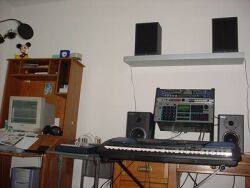
How
disciplined are you in your Home Studio or do you just
treat it as any other room? I am sure that there are
many budding composers out there who would like to know
the right working habits a composer has to inculcate
in order to create successfully. Could you share your
experiences on this?
One
has to be passionate about the work. One has to get
used to working long hours at a stretch with a lot of
focus. It does require a lot of discipline, especially
when time is a constraint. You have to balance professionalism
with creativity and over the years you learn about the
aspects of music that you cannot compromise on. I would
rather ask for a day or two or a few hours more than
publish something that doesn't work because I simply
didn't have enough time.
When
programming music, we make sure that every note is at
its proper position in time and plays for the correct
duration with the right velocity and so on. Things take
time in production. I know of musicians who work 18
hour shifts daily. But at the end of it all, it is probably
worth it.
Composing
requires a lot of patience. But I think that is someone
is passionate enough and serious about the work they
are able to adjust to the demands easily.
What
are your future plans?
My
engineering studies are nearing their end for now, soon,
which hopefully means I'll be able to get back to my
studio. We'll see what happens after that.
I have a few things in mind, but nothing that I can/should
promise. I do hope to program/compose professionally
soon. Hopefully things will work out right.
Good
luck for your magazine and thanks for this interview.
Hopefully I will be able to justify your decision through
my work in the future!
We
wish Ranojoy the best for his future.











 E-zine
Home
E-zine
Home
 Composing
music is looked upon as a task bestowed upon a gifted
few. And to many it's a mystery what goes on in a composer's
mind. So we would like to know since what age have you
been composing? How did it start? Was it like you had
these tunes running in your head like a background score
and you just had to put them down?
Composing
music is looked upon as a task bestowed upon a gifted
few. And to many it's a mystery what goes on in a composer's
mind. So we would like to know since what age have you
been composing? How did it start? Was it like you had
these tunes running in your head like a background score
and you just had to put them down?