|
 What
does a conductor do? Why do you need a conductor? What
does a conductor do? Why do you need a conductor?
I
have joined various choirs for the past 6 years. I will
try to give a general description of what a conductor
does in a choir or in an orchestra, based on my experience.
A
conductor conducts a choir or orchestra. This means he
leads and manages the music sung or played by the choir's
singers or the orchestra's components. Here are the basic
things that a conductor has to do:
1.
Count the beat and keep the tempo.
In
music, there is a certain timing or beat as some people
say. Each song has different timing written on it, such
as 4/4, 6/8, 2/2, 2/4, 3/4, etc. Sometimes a song has
a variable timing. For instance, the first part of a song
can be 4/4, and then change to 3/4 before returning to
4/4 in the end.
The
conductor has to keep count and keep a steady and constant
tempo. For instance, if the singer/musician is "late",
it means that he/she is 1 bar (for instance) behind the
others, or in other words, he/she has lost count. The
conductor has to count steadily using his hands (the hand-flapping
is not without purpose), and the singer/musician has to
watch the conductor all the time. By watching a good conductor
when singing/playing, a choir or an orchestra will sing
in perfect unison, and that is what music is all about:
discipline, unity and harmony.
Every
song/music has variable tempos written on it. This helps
the conductor to understand the "feeling" in
the song that the composer is trying to portray. Some
of these tempos are: allegro, andante, andantino, etc.
Refer to glossary for a comprehensive list of these tempos
and the meaning.
2.
Breathes life into the music by observing all the dynamic
notations.
This
is very important. No matter how well a song/music is
sung or played, it can be flat and meaningless if the
correct dynamics are not followed. At some places, the
music has to be strong, vigorous, and grand, while at
some others it really needs to be slow, mournful or even
graceful. All these "colour" the music, adds
depth and life. And it is the conductor's duty to make
sure all singers/musicians obey all the dynamic notations
in the music. When the conductor sees a dynamic notation
(pianissimo for instance, which means very weak/soft),
he/she may put his/her finger on his/her lips to portray
softness or whispers, especially after a forte dynamic
notation (which means strong/loud). Refer to glossary
for a comprehensive list of these dynamic notations and
the meaning.
3.
Inspire confidence
A
conductor has to be confident, disciplined, punctual and
capable of becoming a leader. Being confident requires
knowing the music inside and out, in terms of the dynamic
notations, the tempo, the timing, and all changes to these
aspects that occur in the music. Everybody has a different
interpretation on every aspect in life, including music.
That's why we need a conductor in a choir or orchestra
in order to have the same interpretation of the music
that is sung or played.
4.
Become a coach
Much
like a coach in soccer and almost every other team sports,
a conductor needs to have a 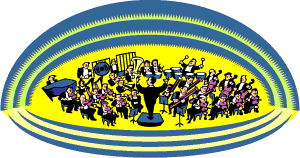 broad
knowledge of the music and all the techniques involved
in it. Soccer coaches implement strategies for attacking,
defending, etc. A conductor (in this case a choir conductor)
implements singing techniques, vocal shaping techniques
and breathing techniques to "mould" the choir
to become his interpretation of an ideal choir. Other
than that, a conductor has to become a human resource
manager. For instance, if a cellist happens to be sick
on the day of the performance, the conductor has to be
able to extract the most out of the available musicians.
The show, as they say, must go on…J broad
knowledge of the music and all the techniques involved
in it. Soccer coaches implement strategies for attacking,
defending, etc. A conductor (in this case a choir conductor)
implements singing techniques, vocal shaping techniques
and breathing techniques to "mould" the choir
to become his interpretation of an ideal choir. Other
than that, a conductor has to become a human resource
manager. For instance, if a cellist happens to be sick
on the day of the performance, the conductor has to be
able to extract the most out of the available musicians.
The show, as they say, must go on…J
5.
Serve as a customer service officer.
In
a performance, interaction is everything. A conductor
has to be able to encourage the choir or orchestra to
interact accordingly with the audience. For instance,
he must tell the choir not to move a muscle before the
orchestra finishes the music, even if the choir has already
finished singing. Or the conductor needs to cue the singers/musicians
to bow after an encore. Or even dance to the music, if
the music is so inclined. This is how a conductor can
give a bit of flair to the musical performance. The conductor
also has to be tactful. Why? See below….
6.
Be aware of harmony
Singers
and musicians are humans, after all. They make mistakes,
and when they do, harmony really goes out the window.
The conductor has to have a good hearing to sense a "false"
note or two among the singers or musicians. And this is
where he has to be tactful. He CANNOT scold individual
member of the choir or orchestra. That's just rude. He
can refer to the section that makes mistakes, but not
the individual, even if he knows for sure that a particular
person made the mistake.
 Glossary Glossary
Dynamic
notations:
f = Forte (loud)
mf = Mezzo forte (slightly softer than Forte)ff = Fortissimo
(louder than Forte)
fff = Fortississimo (loudest)
p
= Piano (soft)
mp = Mezzo Piano (slightly softer than Piano)
pp = Pianissimo (softer than Piano)
ppp = Pianississimo (softest)
NB:
More than 3 f's or 3 p's in a composition is uncommon.
And the names (forte, pianissimo, etc) are not strictly
necessary.
Crescendo
= Getting louder
Decrescendo = Getting softer
Legato = Has to be sung with continuity i.e. flowing
Dolce = Has to be sung with beauty and softness
Dim. (Diminuendo) = Diminishing (Notice the similarity
between Italian and English)
Espressivo = (You guessed it) Full of expression
Subito = all of a sudden. For example: piano subito means
all of a sudden the music softens.
Tempo
notations
Main tempo notations are divided into 5 categories, i.e.:
· Very slow. For instance: Largo and Lento
· Slow. For instance: Adagio
· Medium. For instance: Andante and Moderato
· Fast. For instance: Allegro
· Very Fast. For instance: Vivace and Presto
Other
tempo notations are as follows:
Con Amore = with love
Con Brio = lively
Con Fiesto = festively
Con Espressione = full of feelings or in other words expressively
Con Dolore = with sorrow
Con Maestoso = Majestically
Rit (Ritenuto) = Slowing down
Rall. (Rallentando) = similar to Ritenuto
Accell. (Accelerando) = Accelerates (Italian really sounds
the same with English doesn't it?)
Poco a poco = Slowing gradually
A Tempo = Back to the starting tempo
NB:
Those starting with "con" above can be joined
with any of the main tempo notations, for instance: Andante
con Maestoso, or sometimes the word "con" is
omitted to become Andante Maestoso (which means not too
fast and majestic).
Please
note that the glossary is by no means complete, so if
any of the readers want to add more notations or correct
some of the notations above, they are much welcome.
|











 E-zine
Home
E-zine
Home Dhwanii
- Issue 2
Dhwanii
- Issue 2 Commentary