|
 Being
a student of the Creative arts (Visual Communication),
one thing that struck me was the close synergy between
the written, spoken and visual languages. I even rephrased
the First Law of Thermodynamics (that said that Energy
cannot be created nor destroyed but transformed from one
form to another) as Creativity cannot be created nor destroyed
but can be transformed from one form to another. Made
any sense of that? Well, what I am trying to say is that
Human creativity is like energy that is expressed through
word, spoken language or visual art and if you are good
at one form..you can easily apply the same principles
and techniques to the other. For eg. if you are good in
composing music, you can apply some of the principles
and techniques say..in writing a poem or a song and vice
versa. Being
a student of the Creative arts (Visual Communication),
one thing that struck me was the close synergy between
the written, spoken and visual languages. I even rephrased
the First Law of Thermodynamics (that said that Energy
cannot be created nor destroyed but transformed from one
form to another) as Creativity cannot be created nor destroyed
but can be transformed from one form to another. Made
any sense of that? Well, what I am trying to say is that
Human creativity is like energy that is expressed through
word, spoken language or visual art and if you are good
at one form..you can easily apply the same principles
and techniques to the other. For eg. if you are good in
composing music, you can apply some of the principles
and techniques say..in writing a poem or a song and vice
versa.
Are all these relevant to the topic of our review, you
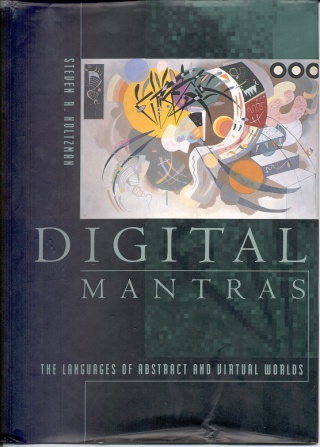
ask? Definitely, as in his book Digital Mantras, the late
Steven Holtzman (a genius who passed away from us even
before he reached his forties) takes us through a wonderful
journey - from his meditative immersion into the sound
of night crickets high up on the slopes of the Himalayas,
through the history of language beginning with Sanskrit,
the laws of grammar as established by Panini and later
Noam Chomsky, through the history of western classical
music, theories and structures as well in parallel, the
abstract art movement characterised by the works of Kandinsky
and brings in the Computer as the modern tool that is
creating the synthesis between visual art, music and language
that is also opening up new mediums of exploration like
Virtual Reality. He finally explores the history and this
new virtual revolution through a spiritual aesthetic and
ends it back in ancient India.
All
this from an author, who has very impressive credentials
-Steven Holtzman (photo on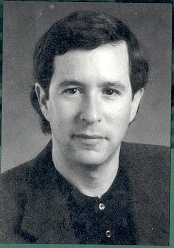 the right) holds under-graduate degrees in both eastern
and western philosophy, a PhD in Computer Science from
the University of Edinburgh. He was also the founder and
Vice-President of Optimal Networks in Palo Alto and he
has composed a number of musical works using digital and
analog techniques. These musical works have been played
in Europe and America.
the right) holds under-graduate degrees in both eastern
and western philosophy, a PhD in Computer Science from
the University of Edinburgh. He was also the founder and
Vice-President of Optimal Networks in Palo Alto and he
has composed a number of musical works using digital and
analog techniques. These musical works have been played
in Europe and America.
A
delightful book all in all but a bit dry for those who
do not prefer 'technical' history. Plus, as a follower
of neo-history, I could not agree with the author on his
cliched description of the Aryans as Central Asian tribes.
As
Marshal McLuhan had stated that radio and television are
mediums that are extensions of our senses like ears and
eyes, the computer is an extension of our mind. What our
mind conceives, we are able to express it through the
computer. Where all this is taking us, I do not know nor
do I think that we'll find an answer. But this book may
give you a glimpse of a future that looks exciting as
well as dreary. I think it was Eric Hoefer who had said
that it is only the learners who inherit the future, the
learned find themselves living in a world that no longer
exists. So, we the creative, have to keep going no matter
what.
Holtzman,
Steven R.
Digital
Mantras : the languages of abstract and virtual worlds
Second printing, 1994 © 1994 Massachusetts Institute
of Technology
|











 E-zine
Home
E-zine
Home Dhwanii
- Issue 2
Dhwanii
- Issue 2